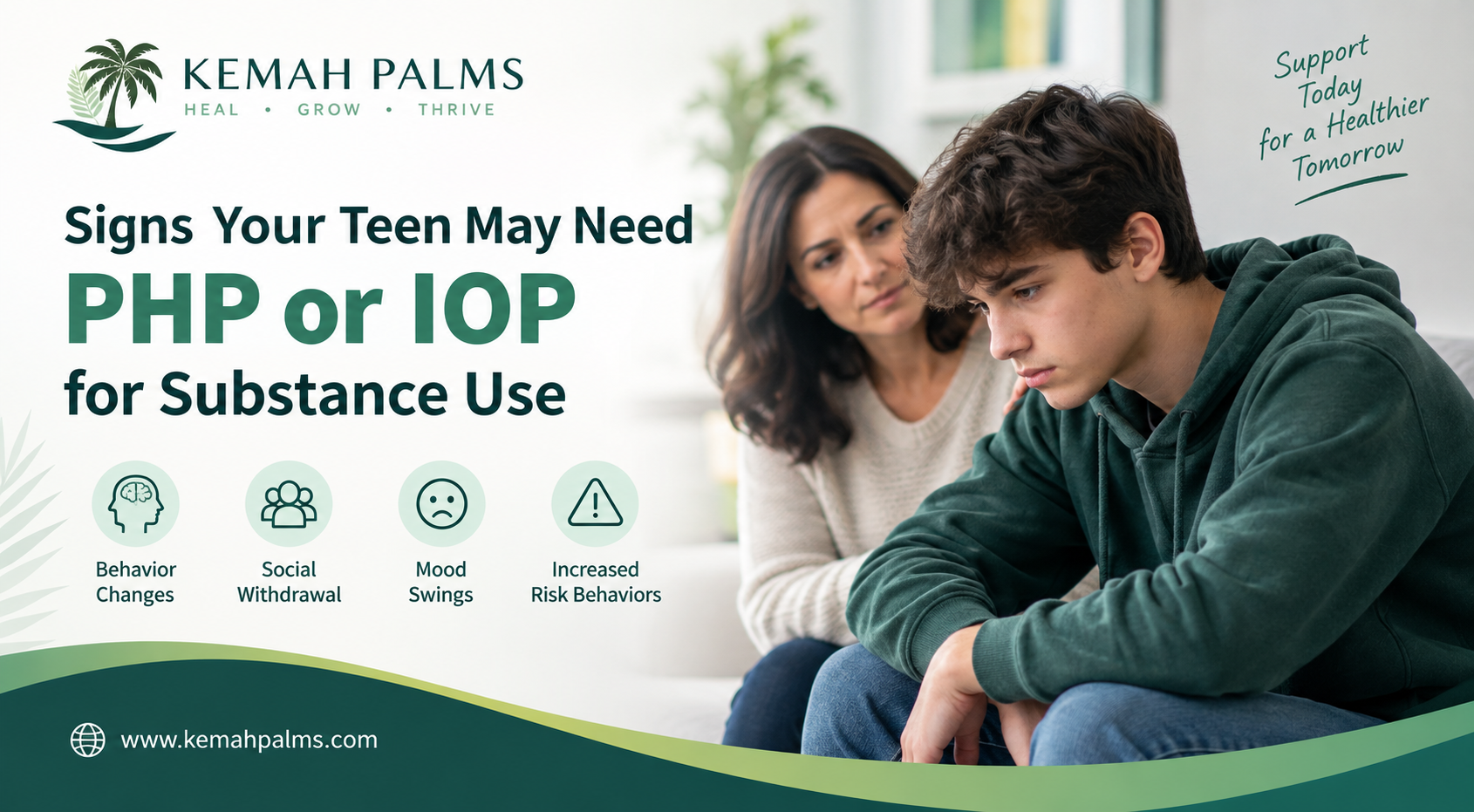
Signs Your Teen May Need PHP or IOP for Substance Use
Most teens who experiment with alcohol or drugs don’t go on to develop a substance use disorder, and it can be hard to know where normal teenage boundary-testing ends and something more serious begins. The shift usually shows up gradually, not all at once, which is part of why it gets missed.
In this article, we’ll walk through the warning signs worth taking seriously, what makes adolescent treatment different from adult treatment, and what a Partial Hospitalization or Intensive Outpatient Program actually looks like for a teenager.
If you’re worried about your teen and want to understand treatment options, call us at Kemah Palms Recovery or visit our admissions page to speak with our team.
What Are Adolescent PHP and IOP?
Partial Hospitalization Programs and Intensive Outpatient Programs are structured levels of care for teens who need more support than weekly counseling but don’t require 24-hour residential treatment. PHP typically runs during the day, several hours a session, with teens returning home each evening. IOP is less intensive, usually a few sessions a week, built around school and family life rather than replacing it. Both combine individual therapy, group therapy, and family involvement, and both are designed specifically around adolescent development rather than scaled-down adult programming.
Signs Your Teen May Need More Support
A single sign rarely tells the whole story. What matters more is a pattern, several of these showing up together and lasting longer than a few weeks:
1. Withdrawal From Family and Friends Pulling away from people and activities they used to care about, especially combined with a sudden shift in friend group.
2. A Real Drop in Grades A noticeable, sustained decline in school performance or attendance that doesn’t match their usual pattern.3. Increased Secrecy New locks on doors, hiding a phone, being evasive about where they’ve been or who they’re with.
4. Mood and Behavior Changes Irritability, mood swings, or aggression that feel out of character, not just typical teenage moodiness.
5. Physical Signs Bloodshot eyes, unusual drowsiness, changes in appetite or weight, or finding vape devices, pills, or other paraphernalia.
6. Prior Treatment That Didn’t Hold A teen who’s already been through standard outpatient counseling but continues using is often signaling they need a more structured level of care.
Overall rates of teen substance use have actually trended down over the past decade, but vaping, cannabis potency, and the risk of fentanyl-contaminated pills remain real concerns, and a teen who’s using today is exposed to a riskier supply than a teen using the same substances ten years ago.
Why Adolescent Treatment Needs to Look Different
1. The Adolescent Brain Is Still Developing The brain’s decision-making and impulse-control systems aren’t fully mature until the mid-twenties, which changes both how addiction takes hold and how treatment needs to be structured.
2. Family Involvement Isn’t Optional A teen goes home to the same family system every evening, so treatment that doesn’t involve parents and siblings is treating only part of the picture.
3. School Has to Stay in the Loop Coordinating with a school, whether that means academic accommodations or simply keeping a teen on track to graduate, is part of adolescent treatment in a way it isn’t for most adults.
4. Co-Occurring Mental Health Is Common Anxiety, depression, ADHD, and trauma frequently show up alongside teen substance use, and treating one without the other rarely holds.
5. Peer Influence Cuts Both Ways The same peer relationships that can contribute to substance use can also become a source of real support in group therapy with other teens facing similar struggles.
PHP vs. IOP: Which Level Actually Fits?
The two levels aren’t interchangeable, and the right starting point depends on how much structure a teen currently needs.
1. Time Commitment PHP typically runs five days a week for several hours a day, closer to a full-time schedule. IOP is usually three to five sessions a week, a few hours each, built to coexist with a regular school day.
2. Level of Supervision PHP offers the highest level of outpatient structure and often follows a higher level of care, like a recent hospitalization or a period of heavy use. IOP suits a teen who’s more stable but still needs consistent support.
3. School Involvement PHP sometimes requires temporary adjustments to a school schedule, with academic support built into the program. IOP is designed to run alongside a normal school day without major disruption.
4. Step-Down Path Many teens start in PHP and step down to IOP as they stabilize, rather than choosing one level and staying there for the full course of treatment.
An intake evaluation is really the only reliable way to know which level fits, since two teens with similar-looking substance use can need very different amounts of structure depending on what’s underneath it, home environment, co-occurring mental health, and how long the pattern has been going on all factor in.
What Treatment Actually Involves
Individual Therapy
One-on-one sessions using approaches like CBT and DBT, giving a teen space to work through what’s underneath the substance use, not just the behavior itself. For many teens, this is the first time they’ve had a private space to talk without a parent in the room or a friend group influencing what they say.
Group Therapy
Structured sessions with other teens working through similar issues, which reduces the isolation that often comes with feeling like the only one struggling. Hearing a peer describe the same thoughts a teen has been keeping to themselves tends to land differently than hearing it from an adult.
Family Therapy
Sessions that involve parents directly, since recovery that only happens inside a treatment room rarely survives the drive home. This is also where families work through communication patterns that may have built up over months or years of tension, not just the substance use itself.
Holistic and Experiential Therapy
Options like equine therapy, music therapy, and mindfulness give teens ways to process what’s happening that don’t always require talking about it directly, which matters for an age group that doesn’t always have the words yet. These approaches also give a teen something to genuinely look forward to in a treatment schedule that can otherwise feel heavy.
Talking to Your Teen About Treatment
Bringing this up is rarely easy, and there’s no version of the conversation that guarantees a calm response. A few things tend to help:
• Lead With Concern, Not Accusation: Share specific things you’ve noticed rather than opening with a label like “addict” or “problem.”
• Expect Resistance and Stay Steady: Many teens deny there’s an issue at first. That reaction doesn’t mean the concern is wrong, it’s a common part of the process.
• Involve a Professional Early: A teen is often more receptive to hearing hard truths from a therapist than from a parent, even when the message is the same.
When Should You Reach Out?
Sooner than feels necessary is usually the right call. Waiting for things to get dramatically worse before seeking help is one of the most common regrets parents describe after the fact. An evaluation doesn’t commit a teen to any specific level of care, it’s simply the fastest way to find out what kind of support actually fits.
Call Us At Kemah Palms for Support
At Kemah Palms Recovery, we offer a licensed adolescent outpatient program for teens ages 12 to 17, with PHP and IOP options built around CBT, DBT, and family-focused care. Our team understands the unique challenges teens face, and treatment is designed with those needs in mind from the start. If you’re ready to talk through options for your teen, call us at Kemah Palms Recovery or visit our admissions page. Your communication with us is always private and confidential.