Art therapy for trauma healing is a clinical approach that uses creative expression to help you process pain that may still sit under the surface after addiction. If you’ve stopped using but still feel flooded by shame, grief, anxiety, or a body that never quite settles down, this is where art therapy can make sense, because healing after addiction is rarely just about removing the substance.
What art therapy means in trauma recovery after addiction
Art therapy is not casual crafting, and it is not an art class with a therapeutic vibe. It is a mental health profession that uses creative art-making to improve emotional well-being and process trauma under the guidance of a trained professional. That distinction matters.
After addiction, people often discover that sobriety removes the numbing agent, but not the pain underneath it. Trauma, old losses, broken trust, chronic stress, and nervous system overload can all remain. In other words, the substance may be gone while the reasons it became useful are still active.
That is why art therapy can be so valuable in recovery. It helps people work with experiences that are hard to explain in neat sentences. Sometimes you do not have the words. Sometimes you do, but saying them out loud feels too exposed. Good news, this is exactly the kind of gap art therapy is built to address.
Why trauma and addiction are so often linked
Trauma and addiction overlap for a simple reason: people often use substances to survive what feels unbearable. Alcohol, opioids, stimulants, or other drugs can become a fast way to dull flashbacks, disconnect from body sensations, soften grief, or quiet a mind that never stops scanning for danger.
That coping strategy makes sense in the short term, even if it causes damage over time. Many people in recovery are not just dealing with habit. They are dealing with a body and mind that learned to expect pain.
Research keeps pointing in the same direction. Post-traumatic stress disorder, substance abuse, and trauma are major drivers of demand for visual arts therapy, which tells you this link is not rare or fringe. It is common enough that treatment programs increasingly need tools that go beyond symptom control and help people process what happened.
Why art can reach pain that talk therapy sometimes misses
Trauma is not always stored like a clean story with a beginning, middle, and end. Often it shows up as body tension, scattered images, dread, shutdown, or reactions that seem to come out of nowhere. That is why a purely verbal approach can feel frustrating. You may know you are hurting, but not know how to explain it.
Art gives you another route in.
Drawing, painting, collage, or clay can help turn vague inner pain into something visible. Think of it like taking a foggy feeling and giving it edges. Once it has edges, it becomes easier to notice, tolerate, and talk about. Visual arts therapy is described as a non-verbal therapeutic approach that can address emotional issues at deeper levels than words alone. For trauma survivors, that can be a big relief.
This also explains why creative therapies often fit well inside a whole-person recovery plan. Clinical treatment gives structure and safety. Holistic supports help your system settle enough to use that treatment well. Practices like movement, breathwork, and mind-body relapse tools that build awareness under stress can work alongside art therapy, not instead of it.
Art gives trauma a shape outside of you
One of the most helpful ideas in art therapy is externalization. That means taking an internal experience and placing it outside yourself in the form of an image, symbol, color, or object.
Why does that help? Because pain feels less overpowering when it is no longer just swirling inside your body. A page can hold some of it. Clay can hold some of it. A collage can show the conflict without you having to become the conflict.
Research describes this well. For PTSD, art therapy helps people externalize traumatic experiences and gain a greater sense of control and mastery through the creative process. That sense of distance matters. You are no longer only inside the feeling. You are also observing it, shaping it, and responding to it.
Sometimes that shift is small. Small is enough.
Creative work can calm the body while the mind processes
Trauma healing is not just emotional. It is physical. If your nervous system keeps switching into fight, flight, freeze, or collapse, insight alone may not change much. Your body needs help learning that the present is safer than the past.
Creative work can support that regulation. Repetitive hand movement, attention to color or texture, and focused sensory engagement can slow the stress response. One widely cited finding reports that 45 minutes of creative activity significantly reduced cortisol, with a 75% drop in the primary stress hormone after art making. That does not mean art therapy is magic. It means the body often responds to it in measurable ways.
In recovery, this matters a lot. Lower stress reactivity can mean fewer emotional spikes, fewer moments of feeling hijacked, and more space between a trigger and an urge to numb out. Honestly, that space is where better choices start.
How art therapy supports healing after addiction
The benefits of art therapy in recovery are not abstract. They connect directly to the daily work of staying sober and building a life that feels worth staying sober for.
When you look at recovery through a broader lens, the goal is not only to stop using. It is to learn how to feel, regulate, connect, grieve, and rebuild. That is why many people do best in care that combines clinical treatment with experiential supports. If you are comparing programs, it helps to understand what whole-person recovery care actually includes, because emotional healing tends to stick better when physical, psychological, and spiritual needs are treated together.
It helps you name emotions before they turn into relapse triggers
A lot of relapse risk builds quietly. Not from one dramatic event, but from unrecognized emotion piling up. Anger that looks like irritability. Grief that looks like numbness. Fear that looks like control. Loneliness that looks like “I’m fine.”
Art therapy helps bring those emotions into view sooner. Instead of waiting until pressure boils over, you work with what is already there. Color choices, symbols, missing parts, repeated images, or even resistance to the task can reveal a lot. Then those reactions can be explored before they become behavior.
This kind of emotional awareness is not soft. It is practical relapse prevention. If you can recognize what you are actually feeling, you have a better chance of responding with a healthier coping skill instead of a substance.
It creates safer ways to process shame, grief, and loss
Recovery often brings a brutal kind of clarity. People start seeing what addiction cost them, relationships, time, trust, health, or parts of themselves they barely recognize anymore. That can bring deep shame and grief.
The catch is that shame tends to shut people down. Art therapy gives you a slower, gentler way in. You do not have to tell the whole story at once. You can draw a cracked bridge. Make a collage of what was lost. Shape grief into something your hands can hold. That gradual pacing matters because trauma work should not flood you.
Experts in trauma-focused art therapy have emphasized that the work should respect each person’s pace and avoid forcing unresolved material, with empathy, time, and professional knowledge shaping the process. That is exactly what makes this safer than just digging around alone.
It helps you rebuild identity beyond “addict” or “traumatized”
People in recovery often get stuck inside labels. Even when those labels describe real pain, they can become too small. You are more than the worst thing that happened to you, and more than the worst thing you did while trying to survive it.
Art therapy can help repair self-image because it supports meaning-making. A 2026 review concluded that art therapy helps trauma healing by nurturing the sense of self. That idea matters more than it may sound at first. Recovery lasts longer when you are not only avoiding relapse, but also reconnecting with values, strengths, faith, purpose, creativity, and hope.
That is one reason creative therapies are often paired with movement-based work. For some people, combining art with body-centered recovery practices like therapeutic yoga helps reconnect the mind, body, and spirit in a way that feels more complete than talk therapy alone.
What a trauma-informed art therapy session may look like
A lot of people picture art therapy as sitting in a room and being told to paint your feelings. Real sessions are usually more grounded than that.
A trauma-informed art therapy session is structured around safety. The therapist may begin by checking how activated or settled you feel. There may be a brief grounding exercise. Then you might move into a prompt, or you may be invited to work more freely and see what emerges. Afterward, the therapist helps you reflect on what came up, without forcing meaning that does not fit.
The point is not to perform. The point is to notice.
Common activities, from drawing a safe place to working with collage or clay
Sessions can use directive or non-directive methods. Directive means the therapist offers a specific prompt, such as drawing a safe place, creating an image of your stress, or making two pictures that show “what I show others” and “what I feel inside.” Non-directive means you choose what to create and the therapist follows your lead.
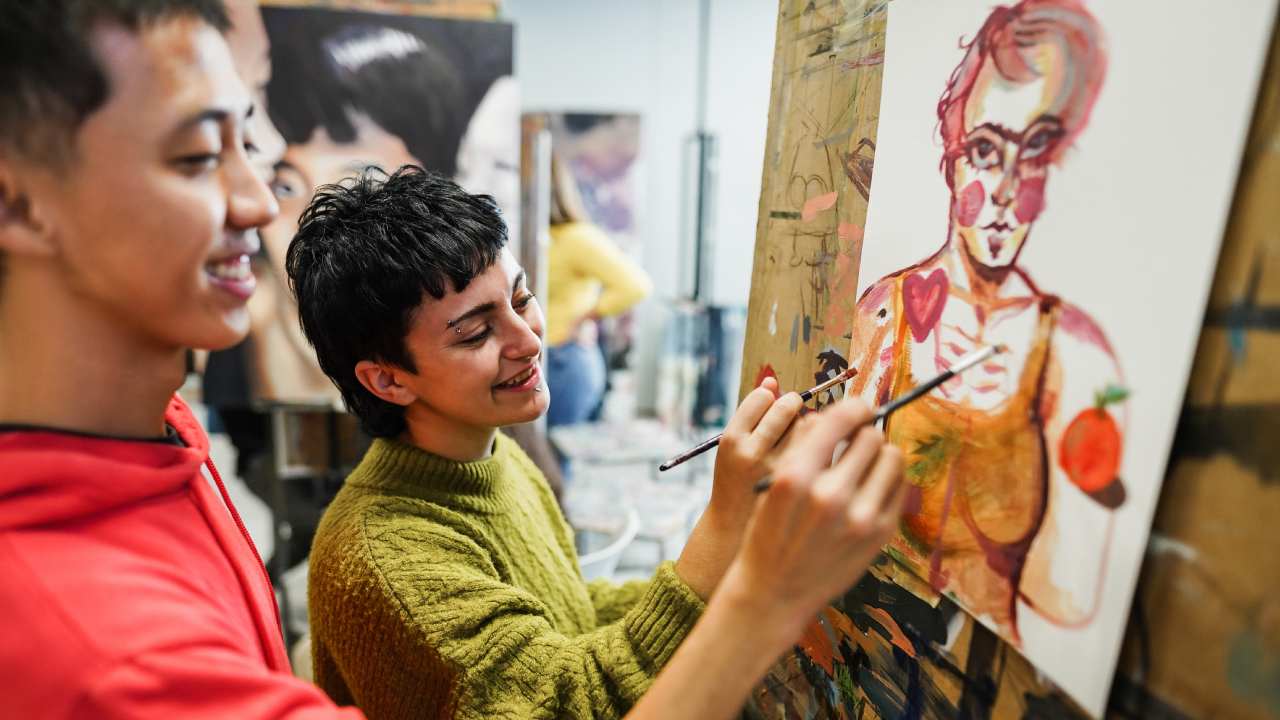
Materials vary too. Some people use markers, watercolor, or pastels. Others do better with collage because choosing and arranging images feels less intimidating than drawing from scratch. Clay can help people who need grounding through touch and pressure. The goal is expression and reflection, not technical skill.
And yes, stick figures count.
What the therapist does during the process
The therapist is there for much more than handing you supplies. A credentialed art therapist watches for signs of overwhelm, helps pace the work, notices patterns you may miss, and connects what appears in the art to your larger treatment goals.
That could include emotional regulation, grief processing, shame reduction, trauma recovery, or relapse prevention. Art therapy has its strongest evidence for trauma and PTSD when creative expression is combined with psychotherapy in clinical interventions delivered by credentialed art therapists. That is why a real therapeutic setting matters.
This is also why art therapy differs from a hobby group, even if both feel calming. A hobby can soothe. Therapy is designed to heal.
What if you do not feel creative
This fear stops a lot of people before they start, and it really does not need to.
You do not need talent. You do not need experience. You do not need to make anything beautiful. Art therapy is often more about the process than the final artwork, and people with no visual-art experience can still benefit. In practice, the “bad at art” clients are often the ones who surprise themselves most.
Good news, there is no grade.
What the research says, and where the limits are
The research on art therapy for trauma is promising, and it is growing. But it is not perfect, and saying that out loud builds more trust, not less.
Broadly, the evidence supports art therapy as a useful trauma treatment, especially when it is delivered by trained clinicians and combined with psychotherapy. A review of the field notes that art therapy can reduce stress markers, support emotional regulation, improve meaning-making, and help people externalize trauma in safer ways.
At the same time, not every study is equally strong. Access is uneven, insurance coverage can be patchy, and the workforce is still limited. There are more than 5,000 registered art therapists in the U.S., which sounds like a lot until you consider how many people need care.
Where studies show the strongest benefits
Some of the strongest findings are in trauma and PTSD. A meta-analysis of 33 studies with 4,587 young people found a large reduction in PTSD symptoms after creative arts-based interventions, with Hedges’ g = 0.85. That is a meaningful effect size, not a tiny statistical blip.
Adult findings are encouraging too. In a 12-session arts therapy trial with 192 adults affected by the war in Ukraine, participants showed small to moderate reductions in PTSD symptoms and moral injury, along with gains in resilience and collective self-esteem. Different setting, different population, same basic message: creative therapies can help people process trauma that overwhelms ordinary language.
There is also evidence for related symptoms that often travel with addiction recovery. Research summaries report 75% improvement for anxiety disorders and 60% improvement for depression. Those numbers should not be treated like guarantees, but they do show why interest in art therapy keeps growing.
Why results can vary from person to person
Results differ for good reasons. Trauma history matters. Recovery stage matters. Therapist training matters. Cultural fit matters. So does whether art therapy is used on its own or alongside other supports.
One major review found stronger benefits in some African and Middle Eastern samples and weaker findings in North American samples. That does not mean art therapy “works there but not here.” It means context shapes outcomes, and culturally responsive care matters.
It also means art therapy should not be sold as a cure-all. Some people need stabilization before deeper trauma work. Others do best when creative work is integrated with talk therapy, medication, peer support, spiritual care, or other experiential approaches, including creative and action-based treatment methods used in recovery. The best results usually come from fit, not hype.
How to find the right kind of support
If you want art therapy for trauma after addiction, the safest move is to look beyond wellness language and check for real qualifications. “Healing arts” can mean almost anything online. That is not enough when trauma is involved.
You want someone who understands addiction, trauma responses, pacing, and relapse risk. You also want someone who respects that healing is emotional, physical, and often spiritual too. The right provider will not treat those parts of you like separate departments.
Look for a credentialed, trauma-informed art therapist
Look for an art therapist with recognized credentials, along with experience in trauma and substance use recovery. Depending on the setting, they may also hold additional mental health licensure. What matters most is that they are trained to use art within treatment, not simply offering creativity as inspiration.
This field is regulated for a reason. Trauma work can stir up strong reactions, and a trained therapist knows how to guide the process safely. If a provider cannot explain their training, approach, and boundaries clearly, keep looking.
Questions to ask before you start
Before beginning, ask practical questions. Find out how they handle trauma triggers during sessions. Ask whether they coordinate with your therapist, psychiatrist, sponsor, or treatment team if needed. Ask what materials are typically used, whether sessions are individual or group-based, and whether telehealth is available.
You can also ask how they pace the work if someone has a history of dissociation, panic, or relapse under stress. A good provider will answer calmly and clearly. No vague promises. No pressure.
When art therapy works best as part of a bigger recovery plan
Art therapy is often strongest as one part of a bigger plan. It can complement talk therapy, medication, 12-step or peer support, spiritual care, nutrition support, mindfulness, and body-based therapies.
That matters because recovery tends to go better when treatment is layered. Emotional processing helps you face pain. Nervous system tools help you stay present with it. Community helps you not do it alone. If you are evaluating programs, it helps to know how to spot rehab that supports the full person, not just the diagnosis.
Common myths that stop people from trying it
A few persistent myths keep people away from art therapy, even when it could help. Most of them come from misunderstanding what the therapy actually is.
“I’m not artistic enough”
You do not need artistic ability to benefit from art therapy. The work is not about beauty, talent, or technique. It is about expression, noticing, and reflection.
Some of the most useful pieces in therapy are simple, messy, unfinished, or made of magazine cutouts and glue. What matters is that they help you contact something real.
“If I open this up, I’ll feel worse”
That fear is understandable. Trauma work can feel risky, especially if you have spent years using substances to avoid being overwhelmed.
But trauma-informed art therapy is designed to go slowly. It uses pacing, grounding, and choice. Research on trauma-focused art therapy describes a phased sequence that starts with safety, moves into processing, and then helps people reconnect with daily life. Done well, it does not throw you into the deep end. It teaches you how to enter and leave the material without drowning in it.
“Art therapy is too soft to help real trauma”
This one misses the point. Gentle is not the same as weak.
Art therapy is used in rehab centers, hospitals, schools, psychiatric programs, and community mental health settings. The strongest evidence supports art therapy for trauma and PTSD, especially when it is delivered clinically and paired with psychotherapy. In other words, it is not a side activity for people avoiding “real” treatment. It is a tool that can make real treatment work better.
A gentle first step you can take this week
If this approach speaks to you, keep the first step small. Research one credentialed art therapist in your area. Ask your therapist or recovery program whether they offer expressive therapies. Or spend 15 quiet minutes making a simple image of what safety feels like, then notice what comes up without judging it.
The bigger point is this: healing after addiction often needs more than insight and willpower. When art gives pain a shape, calms the body, and helps you rebuild a sense of self, recovery becomes more than stopping. It becomes returning to yourself, one honest layer at a time.