
Equine therapy for addiction recovery is a structured, horse-assisted form of treatment that helps people practice emotional regulation, trust, and self-awareness in real time. If rehab has felt too clinical, too verbal, or simply not enough, this approach can add something many people are missing: a way to heal through experience, not just conversation.
What equine therapy means in addiction recovery
In plain language, equine therapy for addiction recovery means working with horses as part of a larger treatment plan. It usually happens alongside counseling, medical care, group therapy, and peer support, not instead of them. The goal is not to turn recovery into a riding lesson. The goal is to use guided interaction with horses to help you notice patterns, manage stress, and rebuild confidence.
That distinction matters. Good programs treat horse-assisted work as an adjunct, meaning a supportive layer added to evidence-based care. A licensed clinician or qualified treatment team uses activities like grooming, leading, observing, and reflecting to support recovery goals such as sobriety, emotional stability, and better coping.
People look for these added layers because addiction is both common and stubborn. A large national estimate cited in recovery reporting found that 15.4% of American adults, or nearly 39 million people, struggle with a substance use disorder each year. Relapse is common too. A current federal trial notes that 60% to 70% of patients relapse within six months of hospitalization, which helps explain why many people want more than a clinical-only model. They need treatment, yes, but they also need routine, meaning, connection, and practical ways to stay regulated after discharge.
Why horses can reach parts of recovery that talk therapy may miss
Talk therapy can be deeply helpful. But some parts of recovery do not show up neatly in words. Shame, hypervigilance, defensiveness, numbness, and trauma responses often live in the body long before they become a clear sentence.
Horses can help because they respond quickly to tone, posture, tension, and consistency. They do not care how polished your explanation sounds. They react to what you are actually bringing into the moment. That can make hidden stress easier to see, and easier to work with.
This is one reason horse-assisted work fits naturally into a broader whole-person recovery approach. Like mindfulness, movement, or creative therapies, it gives you another way to practice being present and honest with yourself.
The “mirror effect” in simple terms
The “mirror effect” sounds mystical, but it really is not. It simply means a horse may respond to your cues in a way that reflects your internal state. If you are agitated, inconsistent, or trying to force control, the horse may hesitate, pull away, or become unsettled. If you are calm, clear, and grounded, the horse often responds more smoothly.
That feedback can be powerful because it is immediate and nonjudgmental. Instead of feeling lectured, you get a live demonstration of what your body language and emotional state are doing. Some clinicians describe this as a shortcut to self-awareness, especially for people who are used to minimizing or masking distress.
Why experiential work can feel different
Experiential therapies focus on doing, noticing, and reflecting. That matters in addiction recovery because many people are exhausted by talking about their pain without feeling different in their bodies. Ground-based horse work can slow things down enough for you to notice, “I’m holding my breath,” or “I’m getting controlling because I feel unsafe.”
Good news, this is easier to grasp once you experience it. You do not need the perfect words. You need a safe setting where you can practice a new response. That is also why experiential work is often paired with other body-based supports, such as learning practical ways to calm your mind between sessions.
What happens during an equine therapy session
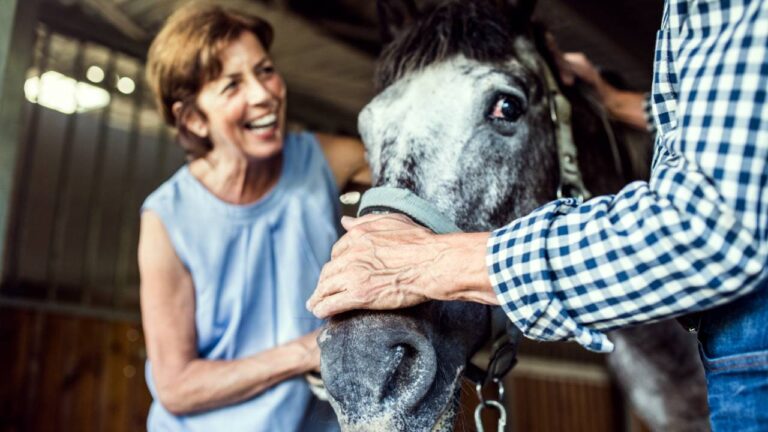
Most equine therapy sessions are simple, structured, and beginner-friendly. You arrive at a barn, ranch, or equine facility, meet the treatment team, and spend time with one horse or a small group of horses. Sessions often last 60 to 90 minutes and are usually held outdoors, which many people find grounding on its own.
A typical session may include meeting the horse, grooming, leading, observing herd behavior, or completing a guided exercise. Afterward, you talk through what happened with a therapist or counselor. The horse becomes part of the process, but the real work is still recovery work: boundaries, patience, emotional awareness, communication, and trust.
Ground activities, grooming, and guided exercises
Many programs focus more on groundwork than riding. That means brushing the horse, walking beside it, practicing direction changes, noticing how it responds, or completing a simple task together. These activities sound modest, but they ask a lot from you in a useful way. Can you stay steady when frustrated? Can you give a clear cue without aggression? Can you notice when you are disconnected?
Over time, these exercises can build awareness and follow-through. Grooming teaches patience and presence. Leading teaches clarity and confidence. Watching herd behavior can open conversations about safety, attachment, and social roles. In a strong program, each activity ties back to a recovery goal.
Do you have to ride, or know anything about horses?
No. Most people start with zero horse experience, and many programs do not involve riding at all. In fact, some psychotherapy models keep all work on the ground because it lowers pressure and keeps the focus on emotional and relational skills.
That is good news if you feel intimidated. You are not expected to “be good with horses.” You are expected to show up, follow safety instructions, and stay open to the process. Staff are there to guide you the entire time.
How equine therapy may support sobriety, stress, and self-trust
The biggest value of equine work is not that horses somehow “fix” addiction. It is that they can help you practice the inner skills recovery depends on: regulating stress, tolerating emotion, staying engaged, and believing you can do hard things.
Researchers have started to see this pattern in early studies. A 2022 scoping review found possible benefits for treatment retention, completion, mental health, self-efficacy, positive emotional affect, and motivation. That does not make equine therapy proven across the board, but it does make it worth taking seriously.
Calmer nervous system, clearer emotions
Stress is not a side issue in recovery. It is often the issue. A 2025 review found that addiction and substance withdrawal can chronically elevate cortisol, which is one of the body’s main stress hormones. When stress chemistry stays high, thinking clearly, resisting cravings, and managing emotion all get harder.
Emerging research suggests horse interaction may help ease some of that hyperarousal. The same review reported that equine interaction was associated with improved comfort, confidence, emotional stability, and communication. Some programs also combine horse work with other forms of active, body-aware treatment, which can reinforce those regulation skills across settings.
Confidence, boundaries, and responsibility
Addiction often erodes self-trust. You stop believing your choices matter, or that you can follow through consistently. Working with a large animal can help rebuild that belief in a concrete way.
There is nothing abstract about leading a horse calmly from one point to another. You have to regulate yourself, communicate clearly, and stay consistent. Caring for a horse also creates a small but meaningful sense of responsibility. Feed times, grooming, safety rules, and routine all matter. For someone rebuilding life after addiction, that structure can be healing.
Better engagement with treatment
Some people shut down in office-based therapy. Others get restless, guarded, or detached. Equine sessions can lower that resistance because they feel active and purposeful. You are not just sitting in a chair explaining yourself. You are doing something, then making sense of it.
That change in format may help people stay involved. In one Norwegian study summarized in the scoping review, horse-assisted therapy participants stayed in treatment significantly longer, averaging 141 days versus 70 days. Not every study has found strong effects on dropout, but the overall signal is encouraging.
What the research says, and where it is still limited
This is where balance matters. Equine therapy has promise, and some of the findings are genuinely encouraging. It is also a young, uneven research area with small studies and mixed program designs. Both things are true.
If you are considering a horse-assisted program, the right mindset is hopeful but grounded. Think of it as a meaningful support, not a miracle claim.
What early studies have found
A good example is a PLOS ONE study of 57 hospitalized patients with substance use disorders. Patients in the equine-facilitated group showed significant improvement in 3 of 4 HoNOS domains and 7 of 8 AQoL quality-of-life dimensions. The study also found that mood improved after each session, and that the benefit appeared to build over time.
Other early research points in a similar direction. The 2022 review found a very small pool of eligible studies, but the pattern suggested possible gains in retention, self-efficacy, mental health, and motivation. One randomized trial outside that review also reported significant improvements in emotion regulation and self-efficacy among participants in equine-assisted therapy.
Why experts still call the evidence “promising,” not proven
The catch is that the evidence base is still limited. The 2022 scoping review found only nine eligible studies total, which is a very small foundation for broad claims. Programs also vary a lot. Some involve psychotherapy, some focus on learning, some include riding, and some do not. That makes comparisons messy.
Researchers are trying to improve that. A not-yet-recruiting federal trial is now evaluating whether post-hospitalization equine-assisted therapy improves mental health and addictive behaviors, including craving, anxiety, depression, relapse counts, and quality of life. That is promising. But until more high-quality trials are completed, honest programs should present equine therapy as supportive and useful, not fully settled science.
Who may benefit most from a horse-assisted recovery program
Equine therapy tends to make the most sense for people who want recovery to feel more whole, not just medically managed. It can be especially helpful if you feel stuck in talk therapy, carry trauma, or need a stronger sense of structure and connection after treatment.
It also fits people who want healing to involve body, mind, and daily life. Recovery is not only about stopping substance use. It is also about learning how to live differently, and experiential therapies can help make that change feel real.
When it can be especially helpful
Early recovery is one strong fit, especially when emotions are raw and words are hard to find. Post-residential treatment is another, because the return home can feel empty and unstructured. Horse-assisted work can add rhythm, responsibility, and community during that vulnerable stretch.
It may also be useful in trauma-sensitive care and dual diagnosis support, particularly when stress regulation is a major challenge. Programs that pair equine work with mindfulness, nutrition, or creative therapies often give people more than one route into healing. For example, someone might build awareness through horses, then deepen expression through creative recovery work that helps trauma surface safely.
When another level of care needs to come first
Equine therapy is not the first stop for every situation. If you are in acute withdrawal, medically unstable, severely depressed with safety concerns, or experiencing psychiatric symptoms that need urgent stabilization, a higher level of care comes first.
That is not a drawback. It is good treatment planning. Horse-assisted therapy works best when the basics are covered: detox when needed, medical oversight, appropriate psychiatric care, and a treatment team that knows how to integrate complementary therapies safely.
How to choose a safe, credible equine therapy program
Not every horse program is therapy, and not every therapy program is clinically sound. You want a setting where the horse work is clearly tied to recovery goals and led by qualified people.
Look for licensed clinicians, trauma-informed care, clear safety procedures, and a treatment plan that connects equine sessions to broader recovery work. Good programs also pay attention to horse welfare. Calm, well-cared-for animals and respectful handling are not extras. They are part of ethical care.
Questions to ask before you enroll
Ask who leads sessions and whether a licensed mental health or addiction professional is involved. Ask whether equine work is part of a licensed treatment plan or simply an activity offered on the side. Ask how goals are set, how progress is reviewed, and what happens if you feel overwhelmed or triggered.
It also helps to ask about group size, safety protocols, and whether activities are individualized. A strong program can explain exactly how horse-assisted work supports your sobriety, not just your enjoyment.
Cost, insurance, and access
Coverage varies a lot. Sometimes the equine component is included inside a licensed rehab program as experiential therapy. Other times it is offered through aftercare, community mental health, or private-pay services. Some programs have grants, scholarships, or sliding-scale options, but you should never assume that horse-assisted care is automatically covered.
This is where practical planning matters. If you are comparing options, it helps to review what separates a strong wellness-based program from one that only sounds appealing. The best choice is not the most picturesque one. It is the one that fits your clinical needs, budget, and long-term recovery plan.
Bringing equine therapy into a long-term recovery plan
Equine therapy can be a powerful part of recovery because it gives you something many people lose in addiction: honest feedback, calming routine, and a felt sense that change is possible. It can support sobriety by helping you regulate stress, rebuild self-trust, and stay engaged in treatment when traditional formats alone are not enough.
Still, horses are one tool, not the whole toolbox. The strongest results usually come when horse-assisted work is woven into a larger plan that includes clinical care, community, and daily practices you can sustain. When recovery supports your body, emotions, and sense of purpose together, it tends to hold up better over time.